- Python 92.1%
- MATLAB 7.6%
- R 0.3%
| Filename | Latest commit message | Latest commit date |
|---|---|---|
|
|
||
| .github/workflows | ||
| docs | ||
| imml | ||
| tests | ||
| tutorials | ||
| .coveragerc | ||
| .gitignore | ||
| .readthedocs.yaml | ||
| CODE_OF_CONDUCT.md | ||
| CONTRIBUTING.md | ||
| LICENSE | ||
| local_ci_test.yml | ||
| pyproject.toml | ||
| README.md | ||











Overview | Key features | Installation | Usage | Free software | Contribute | Help us | Citation
Overview
Multi-modal learning, where diverse data types are integrated and analyzed together, has emerged as a critical field in artificial intelligence. However, most algorithms assume fully observed data, an assumption that is often unrealistic in real-world scenarios. To address this gap, we have developed iMML, a Python package designed for multi-modal learning with incomplete data.
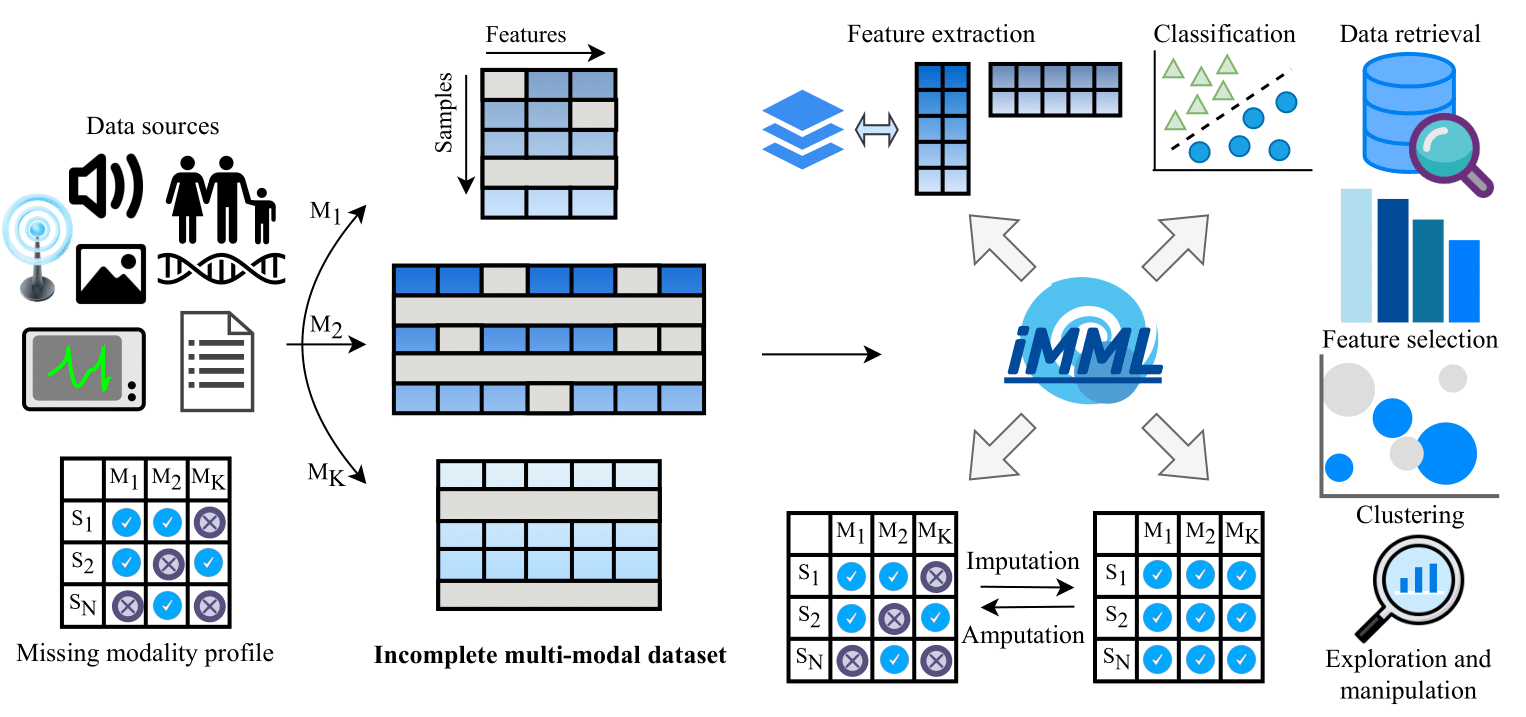
Overview of iMML for multi-modal learning with incomplete data.
Key features
The key features of this package are:
- Coverage: More than 25 methods for integrating, processing, and analyzing incomplete multi-modal datasets implemented as a single, user-friendly interface.
- Comprehensive: Designed to be compatible with widely-used machine learning and data analysis tools, allowing use with minimal programming effort.
- Extensible: A unified framework where researchers can contribute and integrate new approaches, serving as a community platform for hosting new methods.
Installation
Run the following command to install the most recent release of iMML using pip:
pip install imml
Or if you prefer uv, use:
uv pip install imml
Some features of iMML rely on optional dependencies. To enable these additional features, ensure you install the required packages as described in our documentation: https://imml.readthedocs.io/stable/main/installation.html.
Usage
For this example, we will generate a random multi-modal dataset, that we have called Xs:
import numpy as np
Xs = [np.random.random((10,5)) for i in range(3)] # or your multi-modal dataset
You can use any other complete or incomplete multi-modal dataset. Once you have your dataset ready, you can leverage the iMML library for a wide range of machine learning tasks, such as:
- Decompose a multi-modal dataset using
MOFAto capture joint information.
from imml.decomposition import MOFA
transformed_Xs = MOFA().fit_transform(Xs)
- Cluster samples from a multi-modal dataset using
NEMOto find hidden groups.
from imml.cluster import NEMO
labels = NEMO().fit_predict(Xs)
- Simulate incomplete multi-modal datasets for evaluation and testing purposes using
Amputer.
from imml.ampute import Amputer
transformed_Xs = Amputer(p=0.8).fit_transform(Xs)
Free software
iMML is free software; you can redistribute it and/or modify it under the terms of the BSD 3-Clause License.
Contribute
Our vision is to establish iMML as a leading and reliable library for multi-modal learning across research and applied settings. Our priorities include to broaden algorithmic coverage, improve performance and scalability, strengthen interoperability, and grow a healthy contributor community. Therefore, we welcome practitioners, researchers, and the open-source community to contribute to the iMML project, and in doing so, helping us extend and refine the library for the community. Such a community-wide effort will make iMML more versatile, sustainable, powerful, and accessible to the machine learning community across many domains.
For the full contributing guide, please see:
- In-repo: https://github.com/ocbe-uio/imml/tree/main?tab=contributing-ov-file
- Documentation: https://imml.readthedocs.io/stable/development/contributing.html
Help us grow
How you can help iMML grow:
- 🔥 Try it out and share your feedback.
- 🤝 Contribute if you are interested in building with us.
- 🗣️ Share this project with colleagues who deal with multi-modal data.
- 🌟 And of course… give the repo a star to support the project!
Citation
If you use our package, please cite the following paper:
López, A., Zobolas, J., Dumontier, T. et al. Multi-modal learning with incomplete data. Nat Commun (2026). https://doi.org/10.1038/s41467-026-77212-w